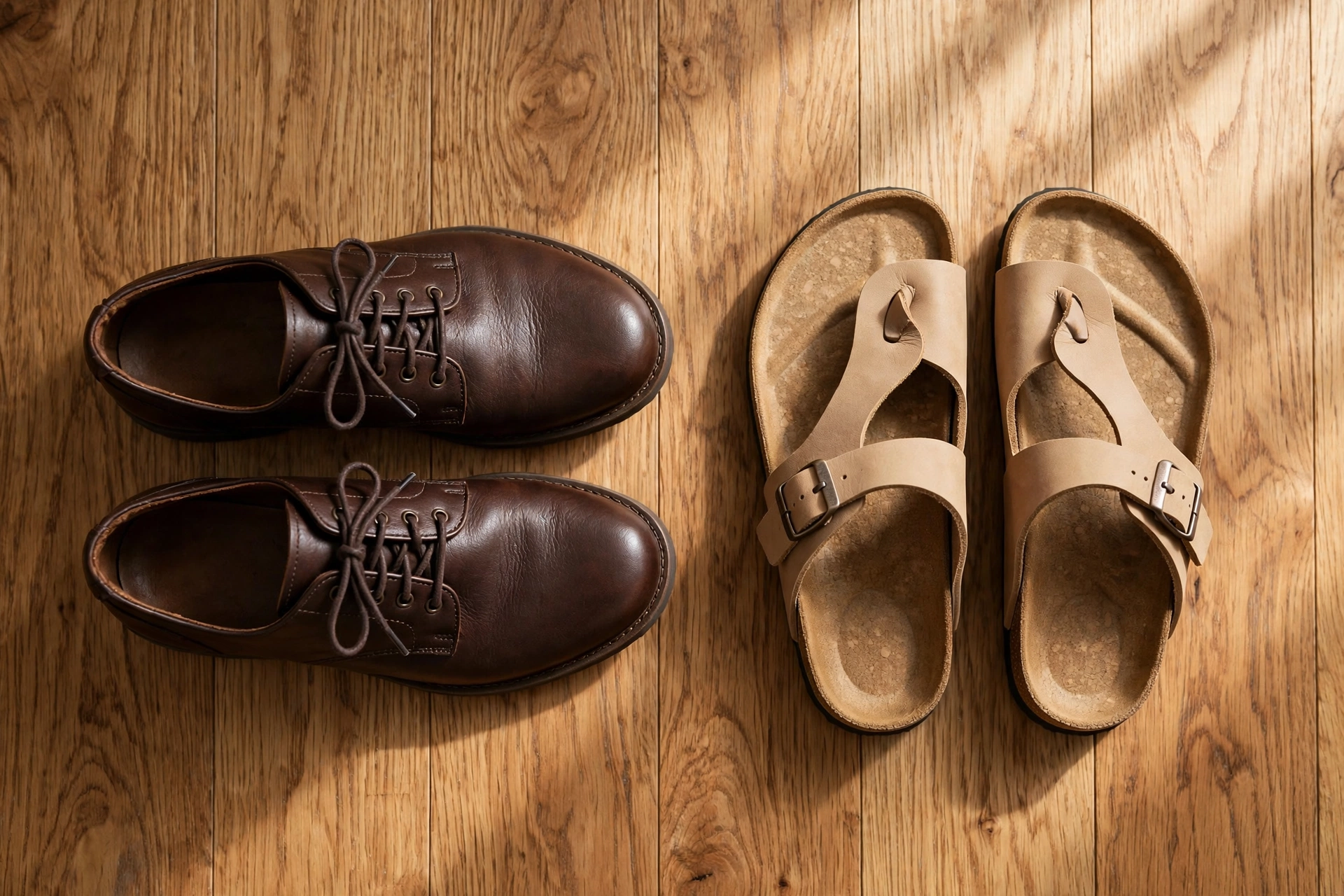
The short answer: Ecco is the better buy for most people — a lower entry price, a broader range, and a sole that holds its shape. Mephisto is the better buy if you want the slimmest leather shoe with hidden cushioning and a shoe that can be refurbished rather than replaced, and you are comfortable paying roughly twice as much for it. The two brands are the pair most buyers actually compare: both European, both built around leather comfort, both on Rick Steves’ packing list — and the comparison is mostly about money, formality, and how each one cushions a step.
We may earn a commission if you buy through links on this page, at no extra cost to you. Read our affiliate disclosure.
How this comparison was researched
This is a research comparison, not a hands-on test. It draws on our full brand profiles of Ecco and Mephisto, which were researched from the brands’ own US stores, major retailers, and owner reports in October 2026. Prices below are list prices re-checked 24 November 2026: the Ecco Soft 7 at $160 on Ecco’s US store (currently about $96–$128 in its early Black Friday sale) and the Mephisto Helen at $175 on Nordstrom and Target, with $174.95 at a specialist retailer. A September 2026 independent review of Mephisto and a long-running travel-forum thread comparing the two brands were also checked, and the comparison table was spot-checked against two or more current sources per figure. Where a claim could not be verified, it was left out. No numeric scores appear here: no scoring standard has been decided yet, and a number would imply a measurement that was never made. The grades below — Better, Even, or Weaker — are qualitative judgments from the evidence in the two profiles.
Ecco vs Mephisto at a glance
| Measure | Ecco | Mephisto | Edge |
|---|---|---|---|
| Entry price (US list) | ≈$130 (Soft Sandal) | $175 (Helen sandal) | Ecco |
| Top of the walking range | ≈$220 (Soft 7 Tred boot) | ≈$425 (Valter slip-on) | Ecco on price |
| Cushioning mechanism | FLUIDFORM direct-injected polyurethane sole | Soft-Air air pockets + latex foam, cork midsole in sandals | Even — different answers |
| Fit | Narrow to medium; Dual Fit insole trick on selected styles | Varies by style; Helen runs small, order up a full size; Mobils H width | Even — both need trying on |
| Range breadth | Sneakers, sandals, boots, outdoor, golf | Sandals, sneakers, slip-ons, boots, dress styles | Ecco |
| Formality | Smart-casual to outdoor | Classic leather, dressier | Mephisto |
| Waterproof options | Soft 7 Gore-Tex $180, Tred boots $200–$220 | Waterproof styles exist, not the range’s focus | Ecco |
| Long-term value | PU soles can degrade if stored unworn | Refurbishment and resoling service | Mephisto |
| Availability | Large US retail footprint, easy to try on | Smaller footprint; some styles not stocked in the US | Ecco |
Prices are list prices from the brands’ own US stores and major US retailers, checked 24 November 2026. Sale prices run lower — Ecco’s Black Friday sale cuts the Soft 7 to about $96–$128, and Mephisto’s Helen Brights was listed at $79.50 on its US store in October — and vary by colour and size. Always check the current price before buying.
Price: what the gap actually buys
The gap is real and it is the first thing to settle. Ecco’s walking range lists at about $130–$220. Mephisto’s lists at about $175–$425. At the entry point the difference is roughly $45 — the Soft 7 at $160 against the Helen at $175 — but at the top end it widens to roughly $200, and the middle of the Mephisto range, the styles most owners actually buy, sits at $280–$350.
What the extra money buys is not more cushioning. It buys three things: hand-finished leather construction from a smaller French maker, a refurbishment service that keeps the shoe in use for years, and a slimmer, more formal shoe. The Soft-Air cushioning itself is not a more expensive mechanism than FLUIDFORM — an air layer costs no more to make than a poured polyurethane sole. The price is in the leather, the finishing, and the service around the shoe, not in the comfort technology.
That matters because it reframes the question. If you are comparing a $160 Soft 7 with a $175 Helen, you are comparing two entry points to the same idea at nearly the same price, and the decision is about fit and style. If you are comparing a $160 Soft 7 with a $300 Rainbow or a $295 Mobils Sabria, you are deciding whether the leather, the formality, and the resoling service are worth roughly double. Most buyers should make the first comparison, not the second.
One practical note on total cost: Mephisto’s US store does not stock every style, and ordering a style it does not carry can add tariff and shipping costs on top of the list price — one owner paid $295 for a Sabria Mobils and then further tariff charges because the style was not stocked in the US. Buy the style the US store actually stocks, from a retailer with free returns.
Cushioning: a poured sole against an air layer
Every step is an impact event. Your heel strikes the ground and your body weight has to stop and reverse direction in a fraction of a second. Cushioning is whatever the shoe does with that impact, and these two brands answer the question in opposite ways.
Ecco’s FLUIDFORM pours the sole. The finished leather upper is placed in a mould and liquid two-component polyurethane is injected in, hardening into the midsole while bonding itself to the upper in one step — no glue line, no stitching between upper and sole. The consequences follow from that single change: no glue line to fail, a sole shaped precisely around the anatomical last, and polyurethane that resists compression set, keeping its shape and cushioning over more miles instead of packing down the way EVA foam does. The trade-off is the storage problem described below: the same polyurethane can break down when a shoe sits unworn for a long time.
Mephisto’s Soft-Air hides an air layer. The midsole contains pockets of air that compress when the foot lands and rebound as it pushes off, spreading the shock of each step across the sole instead of concentrating it at the heel and the ball of the foot. A thin layer of latex foam sits above the air pockets for extra cushioning, and the pockets move air through the shoe as they compress and release. In the Helen sandal the air layer sits inside a cork midsole lined with leather; cork is firm, light, and moulds slightly to the foot over time, so the footbed becomes more shaped to the wearer the longer it is worn. In the Mobils line the same air midsole sits inside a fully padded shoe with latex foam cushioning throughout.
The feel follows the mechanism. Ecco’s sole is firm, low, and close to the ground — the BIOM last is modelled on the natural shape and movement of the foot, and the shoe sits low so the foot rolls naturally. Walkers who like ground feel and a natural stride tend to like it; walkers who want a thick stack of foam underfoot tend to find it firm. Mephisto’s feel is softer on first wear and slimmer than the cushioning suggests: the air layer works without bulk, so a Mephisto sandal can look like a dress sandal and still be walked in for miles. Owners consistently report both brands as comfortable from the first wear with no break-in period — unusual for leather shoes, and a genuine point in both brands’ favour.
Neither mechanism is objectively better. FLUIDFORM wins on shape retention over miles; Soft-Air wins on immediate softness in a slim shoe. Choose on the feel you prefer, not on the technology name.
Fit and widths: the weakest point of both
Fit is where this comparison is most honest, because both brands are weak in the same place and weak in different ways.
Ecco fits on the narrower side of medium, with an anatomical last that hugs the midfoot. It does not sell most styles in dedicated wide widths. Its answer is the Dual Fit system on selected styles: removing the insole creates extra room in the toe box. Many other styles have a removable insole that can be taken out for a little more space, or swapped for a thinner one. That helps, but it is not the same as a wide size, and if you know you need a true wide fit it may not be enough.
Mephisto’s fit is inconsistent, and the reports conflict — which is itself the warning. The Helen runs small: Mephisto’s own guidance, repeated on Zappos and Nordstrom, is to order up a full size. Other reviewers find some styles run slightly large and suggest going half a size down. Mephisto sizes in European sizes with US equivalents, and the conversion is not always even. The Mobils line is the wide option, with an H (extra-wide) width and extra room at the front of the foot, but one owner reported the Sabria Mobils still needed stretching at a shoe repair shop despite being sold as wide, and Mephisto’s own reply was that fit varies by model and material.
The practical rule is the same for both: buy from a retailer with free returns, try the specific style on, and do not trust your usual size. Ecco is the easier brand to try on — its larger US retail footprint means a store is more likely to be nearby — while Mephisto is more often an online purchase, which makes the free-returns rule matter more. For more on the wide-fit question, see our guide to the best wide width walking shoes.
Range and style: breadth against depth
Ecco covers more ground. Sneakers, sandals, boots, outdoor shoes, and golf sit alongside its dress styles, and the range has a sportier end — the BIOM 2.2 textile sneaker at $160, the Offroad hiking sneaker at $175 — that Mephisto does not try to match. If you want one brand to cover walking, work, wet weather, and trails, Ecco is the only one of the two that does it.
Mephisto goes deeper into fewer styles. The range is sandals, sneakers, slip-ons, boots, and lace-ups, plus the Mobils ergonomic line, all in classic leather. The Helen and the Rainbow are sandals that have been in the range for decades; the Valter is a men’s slip-on that carries the highest owner rating on the US store. The look is more formal and more traditional — a Mephisto reads as a leather shoe in a way an Ecco sneaker does not, and the GQ line that the shoes “will make sure your arches feel just as good as they look” is about the dressier end of the range.
For work, the split is similar. Ecco’s Soft 7 and Helsinki 2 cover smart-casual work settings at $160–$175. Mephisto’s Mobils line, at about $295–$330, is the most work-ready option in its range, with full padding and extra width — but it is also the most obviously a comfort shoe in appearance. For a job that is mostly walking, either works; for a job that is mostly standing in one spot, a flat, cushioned work shoe with a wider base is usually the better call either way — see our guide to the best shoes for 12-hour shifts.
Durability and long-term value: storage against resoling
Both brands last a long time when worn regularly, and both have a known weak spot that follows directly from how they are built.
Ecco’s weak spot is storage. A long thread of owner reports describes Ecco soles crumbling, cracking, or turning gummy on pairs stored unworn for months or years — sometimes on shoes with very little wear. The mechanism is polyurethane hydrolysis: the same PU that makes FLUIDFORM soles light and durable in use can break down when exposed to moisture and time without being worn. It is not a defect in a single model; it is a property of the material, and it affects shoes from several brands that use PU soles. The practical lesson is simple: buy Ecco shoes to wear them, wear them regularly, and store them somewhere dry. Do not stockpile a spare pair for next year.
Mephisto’s weak spot is the total cost, not the shoe. The leather and construction last — owners report pairs worn for years, and the brand runs a refurbishment service that rebuilds worn Mephisto shoes and sandals, keeping most soles in stock for repairs. A $200-plus shoe that can be resoled is a different purchase from a $200-plus shoe that gets thrown away, and it is part of what the higher price buys. The September 2026 independent review put it plainly: Mephisto shoes can be an outstanding long-term value if you choose resolable models and care for them — but the high upfront price, conservative styling, and mixed reports on sole wear mean you should buy the right model and care for it.
Over five years of regular wear, the maths can favour Mephisto despite the higher sticker price: one resoled pair against two replaced pairs. But that only holds if you actually use the refurbishment service and if you bought a model it covers. If you will not send a shoe away for repair, Ecco’s lower price is the better value.
Which should you buy?
Buy Ecco if:
- You want the lower entry price — the Soft 7 at $160 against the Helen at $175, with Ecco’s sale prices running lower still.
- You want a broader range: a sportier sneaker, a waterproof leather option, a trail shoe, and a dress shoe from one brand.
- You walk in wet weather and want a genuinely waterproof leather shoe — the Soft 7 Gore-Tex at $180.
- You want to try the shoe on in a store before buying.
- You like a low, natural feel underfoot rather than a tall cushioned platform.
Buy Mephisto if:
- You want the slimmest leather shoe with hidden cushioning — a sandal that looks like a dress sandal and walks like a comfort shoe.
- You want a cork footbed that moulds to your foot over time — the Helen at $175.
- You want the most padded, widest version of the brand — the Mobils line at about $295–$330, with its H width and full leather lining.
- You want a shoe that can be refurbished and resoled rather than replaced, and you will actually use the service.
- You value the sixty-year track record and the hand-finished leather construction enough to pay roughly double at the top end.
Buy neither, and look elsewhere, if:
- You need a guaranteed wide fit without trying the shoe on — both brands are weak here, and a brand that sells dedicated wide sizes is the safer bet.
- Your budget is under $130 — even on sale, neither brand goes there reliably.
- You want maximum cushioning or a soft, bouncy athletic feel — both brands are deliberately firmer and lower than a foam running shoe. Our best cushioned shoes guide covers that end of the market.
What this comparison does not do
Three limits, stated plainly. First, this is a research comparison, not a hands-on test — no one here has worn both brands side by side, and the judgments come from manufacturer specifications, published measurements where they exist, and owner reports. Second, the grades are qualitative by design: Better, Even, and Weaker are judgments, not measurements, and two buyers with different feet can honestly disagree about any of them. Third, comfort is personal in a way a table cannot capture — fit, foot shape, and what your day actually looks like matter more than any grade. Use the comparison to narrow the field to one brand and one or two models, then use the trial period and the free return to decide. If your feet hurt persistently, see a clinician — a shoe is a comfort choice, not a treatment.
For deeper detail on either brand, read our full profiles of Ecco and Mephisto, and see how the two stack up against the rest of the comfort market in our comparison matrix.