The short answer: fit first, then support, then friction. Most uncomfortable shoes fail on one of those three — the wrong length or width, a flat insole with no structure under it, or a spot that rubs. Check the fit, swap in a proper insole, fix the lacing, and wear the right socks, and most shoes get noticeably more comfortable for very little money. If a shoe still hurts in the same spot after all four, the shoe is the wrong shoe — no accessory fixes a shoe that is a size too small.
We may earn a commission if you buy through links on this page, at no extra cost to you. Read our affiliate disclosure.
This guide is research-based, not hands-on testing. The fixes below come from manufacturer guidance, published comfort guides, and owner reports, checked 16 November 2026. Where a fix has a mechanism — why it works, not just that it works — the mechanism is stated, so you can judge whether it matches your problem. Prices are not listed because most of these fixes are either free or low cost; the one place money matters is choosing a better shoe, and our best walking shoes and best cushioned shoes guides cover that with current prices.
Why shoes hurt: three mechanisms
Comfort is not one thing. A shoe is comfortable when three separate jobs all work, and each fix below targets one of them. Knowing which job is failing is what stops you buying an insole for a friction problem.
Fit is geometry. Your foot is a shape; the shoe is a slightly larger shape around it. When the shapes disagree — too short, too narrow across the forefoot, too loose at the heel — pressure concentrates where they touch. Fit problems hurt from the first step and do not improve with wear, because leather stretches a little and foam does not stretch at all. Feet also swell during the day, by roughly half a size, so a shoe that fits at 8 a.m. can pinch by 4 p.m. — which is why trying shoes on in the afternoon is the oldest piece of footwear advice there is.
Cushioning and support are what the shoe does with load. Every step is an impact: your heel strikes and your body weight has to stop and reverse in a fraction of a second. Cushioning spreads that impact out over time; support is the structure — a firm midfoot, a contoured footbed, a stable platform — that keeps the foot aligned while the cushioning works. A shoe with soft foam and no support feels good for ten minutes and tiring over ten hours, because the foot spreads and the arch drops under a sustained load. And foam packs down: the same midsole that felt plush in the shop compresses permanently over months of daily wear, which is why an old shoe can stop being comfortable without any visible damage.
Friction is what breaks skin. Where the shoe moves against the foot — heel slip, a seam across the toes, a stiff edge at the ankle — repeated rubbing causes blisters. Moisture makes it worse: wet skin has higher friction than dry skin, which is why cotton socks, which absorb sweat and stay wet, are a blister risk, and why moisture-wicking socks help. Friction problems are the easiest to fix and the most commonly misdiagnosed: people buy softer shoes for a rubbing problem when the answer is stopping the movement.
What to try first
| Problem | Try first | Cost | How fast it works |
|---|---|---|---|
| Toes cramped or pinched | Check length and width; try a half size up or a wide width | Free to check | Immediately |
| Heel slipping or rubbing | Heel-lock lacing; heel grips | Free / low cost | Immediately |
| Hard, flat feeling underfoot | Swap in a cushioned or contoured insole | Low cost | Immediately |
| Pressure under the ball of the foot | Gel pads under the forefoot | Low cost | Immediately |
| Stiff new shoes | Break in gradually indoors | Free | Over about a week |
| Tight across the forefoot | Stretch with a stretcher or thick socks and heat | Low cost | Overnight to a few days |
| Blisters | Moisture-wicking cushioned socks; stop the rubbing spot | Low cost | Immediately |
| Shoes that used to be comfortable | Replace them — the foam has packed down | A new pair | Immediately |
1. Check the fit properly
Fit is the fix that costs nothing and rules out the most problems. Stand in the shoes, not sit: your feet spread under load. There should be about a thumb’s width — roughly half an inch — between your longest toe and the front of the shoe. The widest part of your foot should sit over the widest part of the shoe; if the shoe pinches across the ball of the foot, the width is wrong, and breaking in will not fix it — leather stretches a little, foam not at all.
Measure both feet, and fit the larger one — most people have one foot slightly bigger. Try shoes on in the afternoon, when feet are at their largest, wearing the socks you will actually wear with them. And check width as well as length: a shoe in the right length but the wrong width will always be uncomfortable, which is why our guides keep coming back to width — the best wide width walking shoes guide exists because width eliminates more shoes than any other single measure.
2. Break them in gradually
New shoes need a settling-in period, especially leather ones. The upper has to soften and mould to your foot, and your foot has to adapt to the shoe’s structure — a firm heel counter or a real arch support can feel strange for the first few wears if you are used to flat shoes. Wear new shoes indoors for 30 to 60 minutes at a time, then build up over about a week. Flex and bend while you walk so the shoe moves with your foot rather than against it.
The rule that tells you whether break-in is working: the discomfort should move and fade. If the same spot hurts in exactly the same way after a week of gradual wear, it is a fit problem, not a break-in problem, and more wear will only make it worse.
3. Swap in a proper insole
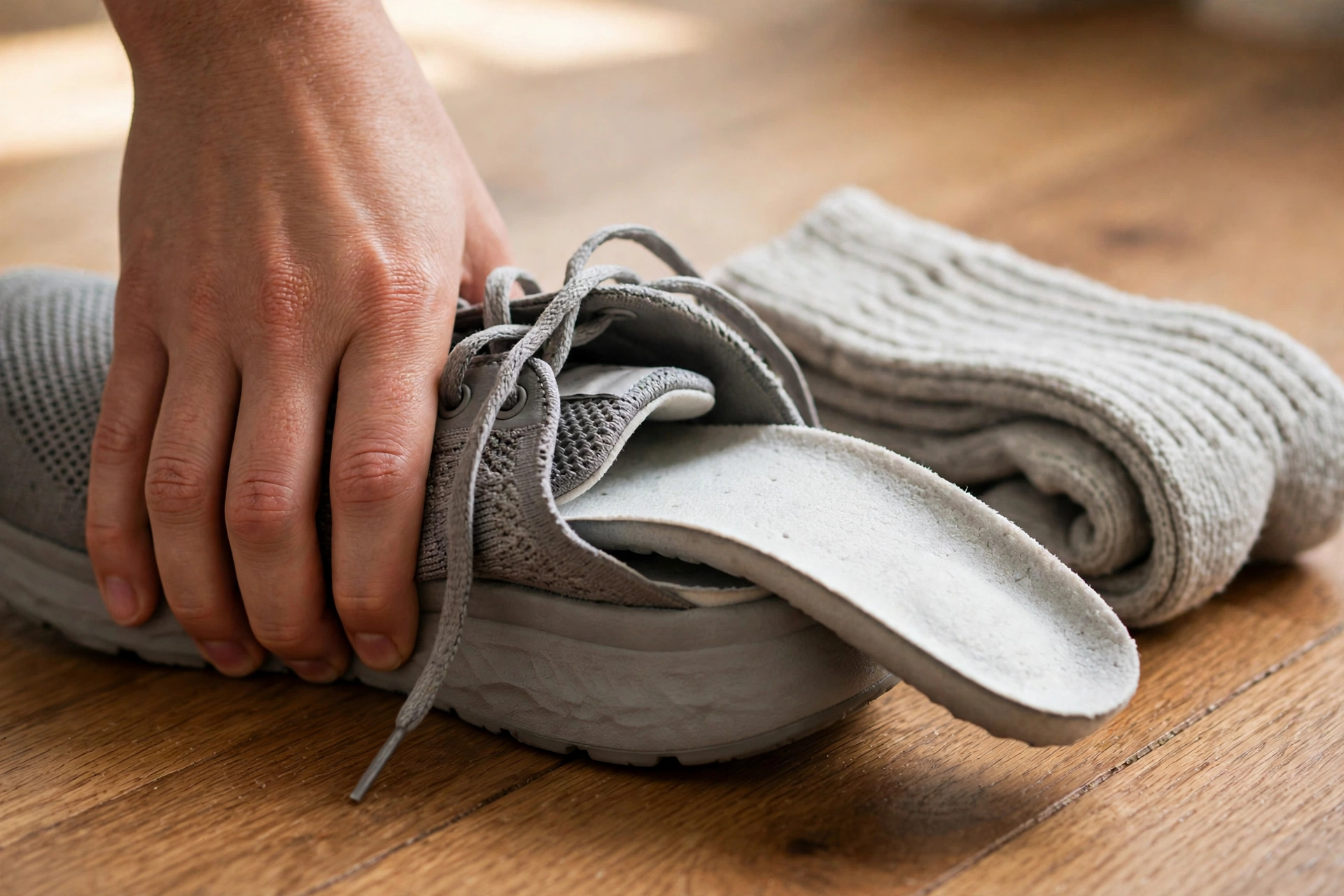
The factory insole in most shoes is a thin piece of flat foam — it is there to cover the stitching, not to support your foot. Replacing it is the single highest-value upgrade in this guide, because the insole is the layer between your foot and the midsole: changing it changes how pressure is spread across the whole foot.
A cushioned insole adds impact absorption under the heel and the ball of the foot, where pressure concentrates. A contoured arch-support insole adds structure — it holds the arch up instead of letting it drop under load, which is what makes standing for hours tiring in a flat shoe. Match the insole to the problem: soft and flat for impact, firm and contoured for support. Our best insoles for standing all day guide compares the types in detail, including which ones suit flat feet and which suit long shifts on hard floors.
One caution: take the factory insole out before adding a new one. Stacking two insoles takes up volume and makes the shoe tighter, which creates the fit problem you were trying to solve.
4. Use gel pads for pressure points
Gel pads are the targeted version of an insole: a small pad placed exactly where it hurts, usually under the ball of the foot or the heel. They work by spreading a point load over a wider area — the gel deforms under pressure instead of letting one spot take all of it. They are cheap, reusable, and the right answer when the rest of the shoe is fine and one spot is not. Heel pads do the same job at the back of the foot, cushioning the heel strike.
5. Wear the right socks
Socks do more than most people give them credit for. The right pair changes two things at once: moisture and padding. Moisture-wicking socks — usually merino wool or a synthetic blend — draw sweat away from the skin, keeping feet drier; dry skin has lower friction than wet skin, so blisters are less likely. Cotton does the opposite: it absorbs sweat and stays wet inside the shoe.
Cushioned socks add a thin layer of padding under the heel and the ball of the foot, which is a small but real addition to the shoe’s own cushioning. Look for a seamless toe, so no ridge rubs across the toes. The one mistake to avoid is going too thick: a very thick sock in a snug shoe takes up room and makes the fit worse. If the shoe is already tight, a thinner moisture-wicking sock is the better choice.
6. Fix the lacing
Lacing is free, takes a minute, and solves two different problems depending on the pattern. If your heel slips, use the heel-lock (runner’s loop): thread the lace through the top eyelet to form a small loop on each side, then pass the opposite lace through the loop before tying. It pulls the heel back into the heel counter without tightening the forefoot.
If the top of your foot hurts, the laces are pressing on it: skip an eyelet over the sore spot, or run the laces straight across (parallel lacing) instead of criss-cross, which spreads the pressure. If the forefoot is tight, leave the lowest eyelets looser and tighten only from the midfoot up. And always lace from the bottom eyelet — starting halfway up leaves the forefoot loose and the heel slipping, which is how blisters start.
7. Stretch tight spots
Leather stretches; mesh and knit give more easily; foam does not stretch at all. If the shoe is leather and tight across the forefoot, a shoe stretcher left in overnight will gain a few millimetres — the slow, controlled version. The faster version is thick socks plus gentle heat: put on thick socks, put the shoes on, and hold a hairdryer 8 to 10 inches from the tight spot while you flex your feet, so the leather softens and moulds around the foot. Leather conditioner or mink oil softens stiff leather generally; stretching spray does the same job in a targeted spot.
What stretching cannot do: fix length. If your toes touch the front, the shoe is the wrong size, and no amount of stretching creates room that is not there. Stretching also cannot fix a tight midsole — if the shoe pinches because of the shape of the foam underfoot, the shape is the problem, and the shoe is the wrong shoe.
8. Add heel grips and toe protectors
Heel grips are small adhesive pads that stick inside the heel of the shoe. They do two jobs: they take up a little volume, so a slightly loose heel stops slipping, and they cushion the spot where the heel counter rubs. Toe protectors — gel caps or sleeves worn over the toes — do the equivalent job at the front, stopping toes rubbing against each other or against a narrow toe box. Both are cheap, and both are the right answer when the shoe is nearly right and one spot is wrong.
9. Replace worn-out shoes
Sometimes the answer is not a fix at all. Foam packs down permanently under daily wear: the midsole that felt plush in the shop compresses over months until it stops springing back. Signs the shoe is done: the midsole is visibly creased and stays compressed when you press it, the heel counter has collapsed sideways, the outsole is worn smooth under the ball of the foot, or the shoe leans to one side when you set it on a flat surface. A shoe that was comfortable and gradually stopped being so is usually worn out, not in need of a new insole — an insole on top of dead foam is a cushion on top of a collapsed mattress.
How long a shoe lasts depends on use, but daily wear on hard floors wears foam out faster than occasional weekend wear. Rotating two pairs lasts longer than wearing one pair twice as long, because foam needs a day off to recover between wears.
10. Choose the right shoe for the job
If several fixes have not worked, the shoe is the wrong shoe for what you ask of it — and that is a buying decision, not a repair. A soft neutral running shoe is a poor standing shoe, however much cushioning it has, because standing is a static load and needs support and width more than softness. A dress shoe with a leather sole is a poor walking shoe, because it has no impact absorption. Match the shoe to the day: our best shoes for standing all day guide compares shoes for static shifts, best walking shoes for days on the move, and best cushioned shoes for maximum softness. And whatever you buy, use the trial period — comfort only shows up after hours on your feet, not in the shop.
What this guide does not do
Three limits, stated plainly. First, this is a research guide, not hands-on testing — no one here has worn every shoe in our guides, and the fixes come from manufacturer guidance, published comfort guides, and owner reports. Second, comfort is personal in a way a list cannot capture: fit, foot shape, and what your day actually looks like matter more than any single fix. Third, these are comfort fixes, not treatment: if your feet hurt persistently, or the same spot keeps hurting no matter what you change, see a clinician — a shoe is a comfort choice, and persistent pain deserves a professional look rather than another accessory.
For the shoe itself, start with our best walking shoes guide, and for the insole question specifically, our best insoles for standing all day guide. The full set of comfort shoe guides is on the guides hub.