The short answer: MBT is the original rocker-sole shoe — a Swiss brand that has built one idea, a curved sole that rolls you forward, since 1996. If you walk a lot and want a shoe that genuinely feels different underfoot, the Colorado X at $217 is the default pick. If the rocker feel, the weight, or the $200-plus price puts you off, a conventional cushioned walking shoe will serve you better — and this profile explains how to tell which camp you are in before you spend the money.
We may earn a commission if you buy through links on this page, at no extra cost to you. Read our affiliate disclosure.
How this profile was researched
This is a research profile, not a hands-on test. Prices and specifications were checked against MBT’s own US store (us.mbt.com) on 26 October 2026, and the MBT-1997’s $208 list price was confirmed against a second source (Target, also $208). Model details come from MBT’s product pages and store filters. Owner sentiment comes from the review counts and ratings published on MBT’s own store — the Colorado X carries 165 owner reviews on one listing — plus buyer reviews republished on Target. The evidence on rocker soles comes from published research, described below, including a study whose findings cut against the marketing. Where a claim could not be verified, it was left out. One quirk of searching for this brand: most live results for “MBT shoes review” are thin affiliate listicles and retailer listings, with no current editorial review of the brand as a whole. That is the gap this profile fills.
What MBT is: the shoe that started the rocker trend
MBT stands for Masai Barefoot Technology. The brand was founded in Switzerland in 1996 by Karl Müller, a Swiss engineer who had spent time with the Masai people of East Africa and noticed their upright posture and the way they walked barefoot on soft, uneven ground. His idea was to build a shoe that reproduced something of that soft-ground walking on hard Western surfaces: a sole that is curved rather than flat, so the foot rolls instead of slapping down.
The result was the first commercial rocker-sole shoe, and MBT has been refining the same concept for thirty years. The brand describes itself as the pioneer of rocker shoe technology, and the claim holds up: the curved-sole category that now includes brands like Hoka, Z-Coil, and Gravity Defyer traces back to MBT’s 1996 prototype. MBT sells in the US, UK, Germany, Italy, Spain, Australia, and across Asia, and its shoes carry a Seal of Acceptance from the American Podiatric Medical Association (APMA), which reviews footwear designs against criteria for foot health.
The brand’s positioning has barely moved in three decades: physiological footwear — shoes designed around how the body moves rather than around fashion — aimed at walkers, people who stand for long shifts, and runners looking for a recovery shoe. Most of its walking range lists between about $200 and $240 in the US.
How the rocker sole actually works
Three ideas do most of the work in an MBT shoe, and they are worth understanding separately because they solve different problems.
The curved sole: rolling instead of flexing
A normal shoe is flat: the foot bends at the ball with each step, and the sole flexes. An MBT sole is curved from heel to toe, like the bottom of a rocking chair, and it barely flexes at all. Instead, the whole shoe rocks forward. The mechanism is simple: the curve turns each step into a roll, so the foot moves from heel strike to toe-off without the midfoot having to bend. The heel lands on a raised, cushioned pad — MBT’s SensorTechnology — and the roll carries the weight forward across the midfoot.
Two consequences follow. First, the roll spreads the load across the whole foot rather than concentrating it at the heel and the ball, which is the main reason walkers describe MBTs as easy on the feet over long distances. Second, the roll is passive: the shoe does some of the work of pushing off, so the calf and foot muscles work differently than in a flat shoe. That second point is also the source of the adjustment period — the muscles are being asked to work in a new pattern, and the first few walks can feel odd or tiring.
PivotAxis: the balance point under the midfoot
Under the midfoot sits the PivotAxis, a firm pivot that the sole rocks around. It is the feature that keeps the rocker from feeling like a wobble board: the pivot gives the foot a defined balance point to roll over, rather than letting the curve tip freely. MBT tunes the strength of the curve into three Rock levels — a gentle curve for first-time wearers, a medium curve, and a strong curve for experienced users — and the product pages state the level for each model. The MBT-1997, the brand’s classic, sits at the highest rock level. Beginners are better off starting low: a strong rock on day one is the most common reason new wearers give up on the brand.
SensorTechnology and the PU insole: the cushioning layer
The heel pad is a shock-absorbing sensor in the heel area, paired with a polyurethane insole that MBT describes as offering strong shock absorption and breathability. The insole matters more than it sounds: polyurethane holds its shape under repeated compression better than the EVA foam in most sneakers, so the cushioning stays consistent over more miles. The trade-off is weight. MBTs are heavy shoes — older models were measured around 600 g per shoe in published research, roughly double a light running shoe — and the current range still feels substantial on the foot. The weight is the price of the thick, curved sole unit.
What the published research actually says
MBT’s marketing leans heavily on studies, and the honest picture is more mixed than the store pages suggest. Two published findings are worth knowing before you buy.
First, a small controlled study (MacRae and colleagues, 20 participants, six months) compared rocker-sole shoes against flat-sole shoes. While wearing the rocker shoes, participants showed greater postural instability than while barefoot — the curved sole makes balance harder, not easier, in the moment. More importantly, six months of wearing rocker soles produced no measurable change in barefoot balance. The rocker changes how you move while you wear it; the study found no evidence it retrains your balance for when you take it off.
Second, a study of 45 marathon runners found that wearing MBTs for three days after a race was associated with lower reported fatigue than wearing trail shoes or regular shoes — but the study was funded by the shoe’s manufacturer, which limits how much weight it can carry.
Neither finding is a reason to avoid MBT, and neither is a reason to buy it for a specific outcome. The fair summary is: the rocker sole changes gait while you wear it, some wearers find that change comfortable over long walks, and the long-term benefits claimed for it are not established by the published evidence. Buy the shoe for how it feels on a long walk, not for a promised result. Anyone with persistent foot pain should see a clinician rather than shopping for a shoe to solve it.
The current range
Prices are list prices from MBT’s US store, checked 26 October 2026. Sale prices run lower and vary by colour and size — several styles list around $98 on sale — and the store frequently runs a 30%-off code, which brought the 1997 down to about $166 at the time of checking.
| Model | Best for | List price (US) |
|---|---|---|
| Colorado X (walking sneaker) | Everyday walking, all-day wear | $217 |
| MBT-1997 / 1997 Classic II (retro sneaker) | Fitness walking, everyday wear | $208 |
| Huracan-3000 / Huracan-3000 II (running trainer) | Running, active walking | $227 |
| MBT-2000 (running shoe) | Running, cushioned walking | $208–$238 |
| M-3000 Lace Up | Everyday walking | $234 |
| Sport 1 | Everyday walking | $187 |
| Modena III | Everyday walking, lighter rock | $139 |
| Yasu / Taka | Everyday walking, entry price | $139 |
| Niwasi Slip On | Easy on and off | $149 |
| Gadi II Lace Up | Everyday walking | $158 |
| M800 | Everyday walking | $164 |
| MT Alpine Sym (Low) (boot) | Cold and wet conditions | $278 |
Colorado X: the default MBT
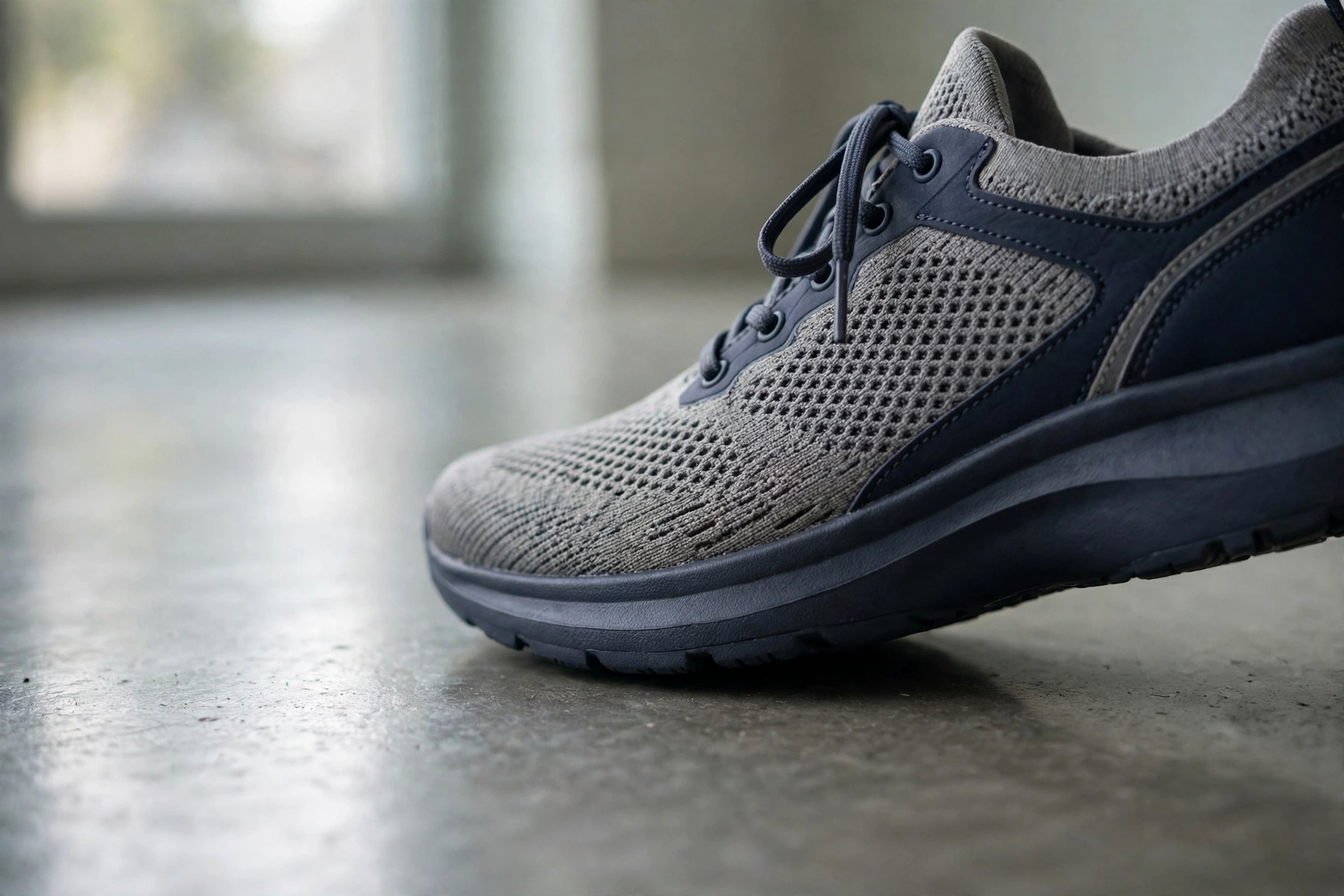
The Colorado X is the brand’s best-known walking shoe and the right starting point for most buyers. It is a mesh walking sneaker on MBT’s rocker platform, with the PivotAxis and SensorTechnology heel, and it carries the most owner reviews in the range — 165 on one men’s listing on MBT’s own store. The recurring theme in those reviews is comfort over long days on foot, which matches the shoe’s design brief. At $217 it sits at the top of the walking range, but it is also the model most likely to be in stock in a full size run. If you want one MBT and you walk a lot, start here.
MBT-1997: the classic
The 1997 is the retro-styled original, rebuilt with the current sole technology: suede and mesh upper, PU insole, mesh footbed for breathability, and the highest rock level in the range. It lists at $208, confirmed on both MBT’s store and Target, and it is the model that best shows what the brand is about — the strongest rock, the most distinctive feel. It is also the model most likely to surprise a first-time wearer, because the high rock level makes the rolling sensation impossible to ignore. Buy it if you already know you like a strong rocker; try the Colorado X first if you are unsure.
Huracan-3000 and MBT-2000: the running end
The Huracan-3000 ($227) and MBT-2000 ($208–$238) are MBT’s running trainers, built on the same rocker platform with lighter mesh uppers. The Huracan is the more engineered of the two, with the brand’s Huracan sole and a design aimed at a smooth heel-to-toe transition at running pace. Both are better thought of as cushioned trainers with a rocker than as racing shoes — the weight rules out speed work, and the rocker rewards a steady pace.
The cheaper end: Modena III, Yasu, Taka
At $139, the Modena III, Yasu, and Taka are the cheapest way into the brand, and they are worth knowing about because MBT is often written off as a $200-plus brand. They use the same rocker concept with simpler uppers and a gentler rock level, which also makes them a better first pair for someone testing whether the concept suits them. On sale, several MBT styles drop to around $98, which is the point at which the brand competes directly with mainstream walking shoes on price.
Fit and widths: the honest picture
MBT lists most styles as a medium fit and sizes in European sizes, with US equivalents printed on each product page. The brand’s own guidance for the 1997 Classic II is to round up if you are between sizes — European sizing does not map evenly onto US sizes, and the brand says to use measured foot length rather than your usual US size. That advice is worth following: ordering your usual US size and hoping is the most common fit mistake with this brand.
MBT does not sell dedicated wide widths in the way some comfort brands do. Wide-footed buyers should check the specific style — the 1997 runs roomier than the Huracan trainers — and buy from a retailer with free returns. If you need a true wide fit, see our guide to the best shoes for flat feet for brands that sell proper wide sizes.
Who MBT suits — and who should skip it
MBT suits you if:
- You walk a lot — several miles a day — and want a shoe that feels genuinely different underfoot.
- You like the idea of a rolling gait and are willing to spend a few days adapting to it.
- You want a thick, durable sole that holds its cushioning over many miles.
- You have tried conventional cushioned walking shoes and found them unremarkable.
- You value the APMA Seal of Acceptance as a sign the design has been reviewed by podiatrists.
For people who spend full shifts on their feet, the Colorado X is a credible option for work — see our guide to the best shoes for 12-hour shifts.
Skip MBT if:
- You want a light shoe — MBTs are heavy, and the weight is noticeable on the first wear.
- You have balance concerns, or your job keeps you standing in one spot rather than walking — the rocker is a walking mechanism, and it feels less stable when you stand still.
- You walk on stairs, cobbles, or uneven ground all day — the rocker is at its worst on poor footing.
- Your budget is under $100 — even on sale, MBT rarely goes there, and the $139 entry models are the floor.
- You want a shoe for running at pace — the weight and the rocker both work against speed.
What owner reports say — including the weak spot
The broad pattern in owner reports is consistent: comfortable over long days, durable uppers and soles, and a distinctive feel that owners either love or abandon. The Colorado X’s 165 owner reviews on MBT’s store skew positive on all-day comfort, and the few Target reviews for the 1997 are five-star — though with only two reviews, that tells you almost nothing.
There is one recurring complaint worth taking seriously, because it follows directly from the construction described above. New wearers regularly report that the shoes feel unstable or strange for the first days, and some report calf or foot tiredness while their gait adjusts. That is not a defect; it is the rocker doing what it is designed to do, and the adjustment period is real. The practical lesson is simple: start with short walks on flat ground, wear them for a few days before judging them, and do not buy a strong-rock model as your first pair. A second, smaller complaint is the weight — owners who expected a light sneaker are consistently surprised.
MBT vs Z-Coil
Z-Coil is the comparison most buyers actually make, because it is the other rocker-sole specialist in the comfort market. The two brands solve the same problem in opposite ways. MBT uses a curved sole that rolls the foot forward; Z-Coil uses a steel coil spring in the heel that absorbs impact. MBT’s range is broader — walking, running, boots, sandals — and its prices run $139 to $278. Z-Coil’s range is narrower and built around the spring, with a more clinical look.
Choose MBT if you want the rolling gait, the broader range, and a shoe that reads as a normal sneaker. Choose Z-Coil if you want maximum impact absorption at the heel and do not mind the distinctive look. Read our full Z-Coil profile for the other side of the comparison, and the comparison matrix for how the two stack up against the rest of the comfort market.
MBT vs Gravity Defyer
Gravity Defyer is the other rocker brand in this price bracket, and the comparison is mostly about how the rock is delivered. Gravity Defyer uses a rocker sole paired with its VersoShock cushioning and a wider, more athletic range, with prices in the same $145 to $200 band as MBT’s core models. MBT’s rock is the stronger and more distinctive of the two — the 1997’s high rock level is a bigger departure from a normal shoe than anything in the Gravity Defyer range — and MBT has the longer track record, thirty years against Gravity Defyer’s shorter history.
Choose MBT if you want the strongest rocker feel and the heritage. Choose Gravity Defyer if you want a rocker that feels closer to a normal athletic shoe. Our Gravity Defyer profile covers that side in detail.
The bottom line
MBT is a straightforward proposition once you see past the thin affiliate listicles that dominate its search results: a Swiss brand that invented the rocker sole in 1996 and has spent thirty years refining one idea. The Colorado X at $217 is the right first pair for most people, the 1997 at $208 is the purest expression of the concept, and the $139 entry models are the cheapest way to test whether the rock suits you. The two things to get right are the adaptation period — short walks on flat ground first — and the fit, which runs in European sizes and rewards measuring your foot. Get those right and an MBT is a durable, distinctive walking shoe. For the rest of the brand landscape, browse the full brands hub, including our profiles of Ecco, Gravity Defyer, and Z-Coil.