The short answer: Vionic is the podiatrist-founded comfort brand built around one idea — a contoured orthotic-style footbed inside a normal-looking shoe. If you want structured arch support without wearing something that looks orthopedic, the Tide II sandal at $100 is the default pick, and the Uptown Loafer at about $145 is the dress-code-safe version. If you want soft, flat cushioning, or you dislike a firm arch underfoot, Vionic will feel wrong from the first step — and this profile explains how to tell which camp you are in before you spend the money.
We may earn a commission if you buy through links on this page, at no extra cost to you. Read our affiliate disclosure.
How this profile was researched
This is a research profile, not a hands-on test. Prices were checked on 20 November 2026. Vionic’s own store blocked our browser outright — a Cloudflare block on the whole site, with no way through — so the Tide II’s $100 list price was confirmed from the store’s indexed product page, which also confirms the APMA Seal of Acceptance for that model, and the remaining prices were checked against retailer listings: Dick’s Sporting Goods for the Uptown Loafer at $144.99, Amazon list prices for the 23Walk range, and Nordstrom sale reporting for the Kimmie Court. Model details come from Vionic’s product descriptions as carried by those retailers, and owner sentiment comes from the published review counts and ratings on retailer sites — the Uptown Loafer’s 4.7 stars from 4,199 reviews at Dick’s — plus independent brand guides and owner reports. Where a claim could not be verified, it was left out. One quirk of searching for this brand: most live results for “Vionic shoes review” are thin affiliate listicles, single-product blog posts, and retailer listings, with no current editorial review of the brand as a whole. That is the gap this profile fills.
What Vionic is: the podiatrist’s shoe company
Vionic began in a podiatrist’s clinic, not a fashion studio, and that origin still explains the shoes. Australian podiatrist Phillip Vasyli founded the business in 1979 and invented one of the first heat-moldable orthotics in 1987, a low-cost alternative to custom orthotics for his patients. A few years later he put the same idea into over-the-counter insoles and then into shoes and sandals with the support built in — the Orthaheel line, marketed as the first orthotic available without a prescription. The Tide flip-flop, still the brand’s best-known style, was an early success: a sandal that showed the contoured insole openly instead of hiding it.
In January 2013 the Orthaheel brand became Vionic with Orthaheel Technology, and the company moved its headquarters to San Rafael, California. In October 2018 the footwear group Caleres bought Vionic Group for $360 million. Today the range covers sandals, sneakers, loafers, flats, boots, and slippers for men and women, most of them listing between about $100 and $175 in the US.
The positioning is the opposite of most comfort brands on this site. MBT sells a rolling gait, Mephisto sells leather and air, Ecco sells cushioning and athletic range. Vionic sells alignment: a footbed designed by a podiatrist that holds the foot in a particular position. Everything else — the styles, the materials, the price — is built around that one idea.
How Vio-Motion actually works
One idea does most of the work in a Vionic shoe, and it is worth understanding because it is not a thick foam wedge or a rocker. It is a shaped footbed.
The contoured arch: supporting the middle of the foot
The Vio-Motion footbed rises under the arch, where a flat shoe leaves a gap. When the foot lands and the arch flattens under load, the contour meets it instead of letting it collapse inward. The mechanism is simple: the footbed fills the space the arch would otherwise fall into, so the load spreads across the whole foot rather than concentrating at the heel and the ball. This is also why the support feels firm rather than soft — a contour that holds its shape under load cannot be as plush as foam that gives way, and the two goals trade off against each other.
The deep heel cup: holding the heel in place
The footbed cups the heel, cradling it so the foot sits in the same place step after step instead of sliding around inside the shoe. A stable heel matters because the heel is where the foot first meets the ground, and a heel that rolls inward on landing drags the rest of the foot with it. The cup works with the arch contour: the arch supports from below, the cup steadies from behind.
Shock absorption and forefoot flexibility
Under the heel and forefoot sits a layer of shock-absorbing cushioning, usually EVA, that takes the edge off each step. The forefoot of the footbed is designed to flex where the foot bends, so the shoe moves with the stride rather than fighting it. In many styles the whole footbed is removable, so it can be swapped for a custom insert — useful if you already have orthotics you like, and a sign that Vionic thinks of the footbed as the product, not an afterthought.
The adjustment period: why it takes two weeks
Vionic’s own guidance is the honest part of the story: wear a new pair for a few hours at a time and allow one to two weeks to reach full comfort. A foot that has spent years in flat shoes has muscles and ligaments adapted to that position, and a contoured footbed asks them to work differently. Some owners report the arch feeling intrusive for the first few days and then disappearing; others find the firmness never fades and return the shoes. Neither outcome is a defect — it is the predictable result of putting a structured support under a foot that is used to none. The practical consequence is that Vionic is a poor impulse buy: it needs a few days of indoor wear before you know whether it suits you.
What the owner reports actually say
The broad pattern in owner reports is consistent: the support is real and noticeable from the first wear, the shoes hold up well over time, and the firmness divides buyers. The Uptown Loafer carries 4.7 stars from 4,199 reviews at Dick’s Sporting Goods — a large enough sample to mean something, unlike the handful of reviews on some brand stores — and the recurring praise is for a loafer that looks like office wear but supports like a walking shoe. The Tide II is the brand’s best-seller by most counts, with the brand’s own store listing thousands of five-star reviews, and owners consistently describe it as the sandal that replaced their flat flip-flops.
The recurring complaint is the same as the recurring praise, seen from the other side: the arch support is strong, and for some feet it is too strong. Owners who love Vionic describe the feeling as the shoe “holding” their foot; owners who return them describe the same feeling as pressure under the arch. A second, smaller complaint is fit: some styles run narrow, the sandals come in whole sizes only, and the footbed takes up room, so high-volume feet need the wide width. The honest summary is that Vionic is a love-it-or-return-it brand, and the return rate is the price of a support system that does not compromise for softness. Anyone with persistent foot pain should see a clinician rather than shopping for a shoe to solve it.
The current range
Prices are list prices from Vionic’s own store and major US retailers, checked 20 November 2026. Sale prices run lower and vary by colour and size — the Uptown Loafer has been seen at $83 on Amazon and the Kimmie Court at $75 at Nordstrom — and Vionic shoes are discounted often.
| Model | Best for | List price (US) |
|---|---|---|
| Tide II (women’s/men’s toe-post sandal) | Warm weather, everyday walking | $100 |
| Uptown Loafer (women’s loafer) | Office, dress codes, travel | $144.99 |
| Walker Classic (men’s/women’s leather walking shoe) | Classic leather walking shoe | Varies by retailer (see note) |
| 23Walk Classic (women’s sneaker) | Everyday walking, light exercise | $120 |
| 23Walk 2.0 (women’s sneaker) | Everyday walking, updated 23Walk | ≈$160 |
| Walk Max (performance walking sneaker) | Long walks, most cushioning in the range | ≈$150–$175 |
| Kimmie Court (women’s court sneaker) | Casual sneakers with support | ≈$150 |
Note on the Walker Classic: no consistent list price was published at the time of checking — the model is sold mainly through retailers and marketplaces now, with street prices varying widely by size and colour. The $120–$160 band of the 23Walk range is the realistic expectation for a current Vionic walking shoe.
Tide II: the default Vionic
The Tide II is the brand’s best-known style and the right starting point for most buyers. It is a toe-post sandal with the full Vio-Motion footbed — contoured arch, deep heel cup, shock-absorbing cushioning — in a water-friendly sandal that Vionic calls the world’s first orthotic sandal. It lists at $100 on Vionic’s own store and carries the APMA Seal of Acceptance. It is the model that best shows what Vionic is for: a sandal that supports the foot properly instead of a flat flip-flop that offers nothing. The one thing to get right is the toe post, which takes getting used to if you have not worn one before, and the whole-size-only sizing — size down if you are between sizes.
Uptown Loafer: the dress-code-safe pick
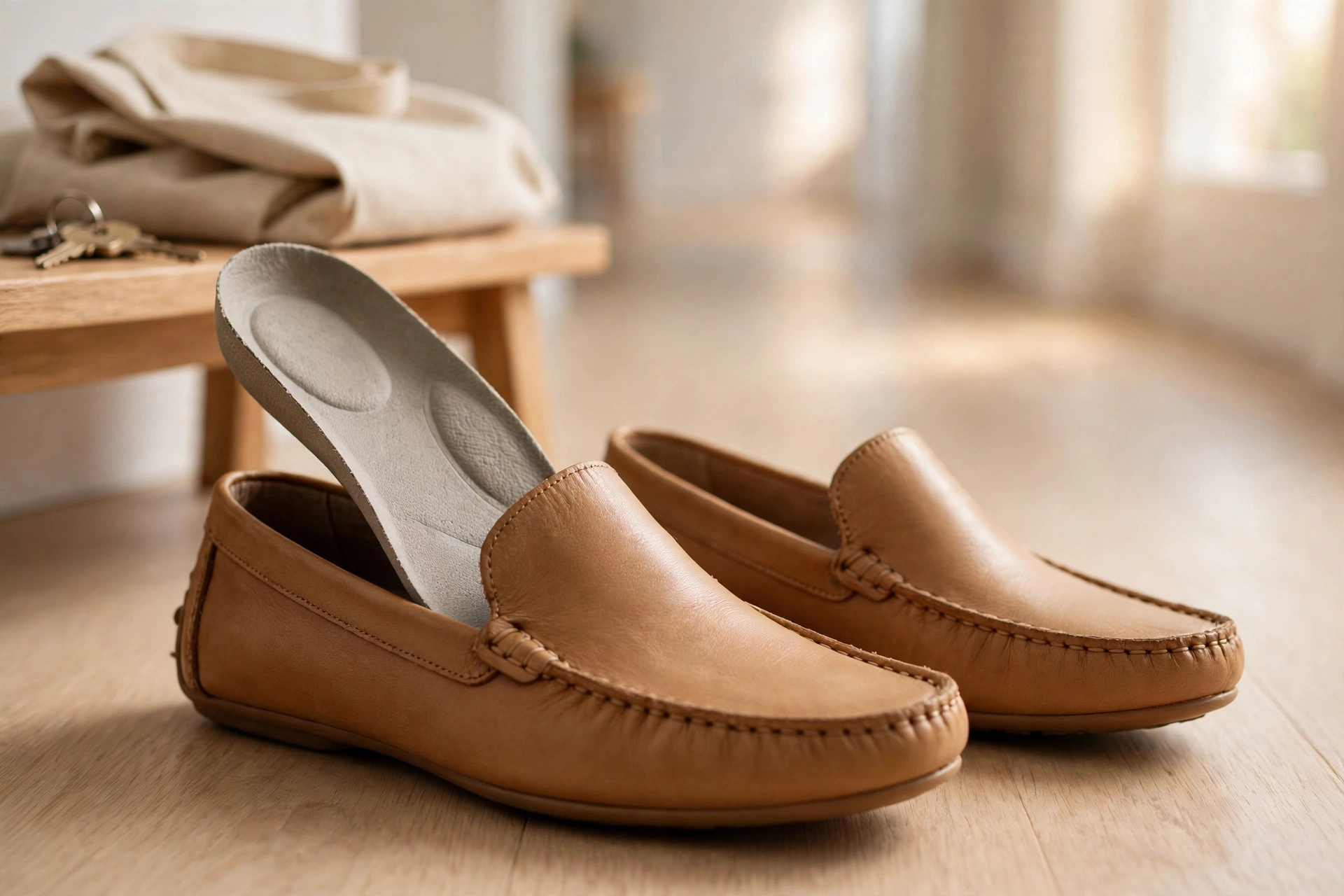
The Uptown Loafer is the most-reviewed shoe in the range — 4.7 stars from 4,199 reviews at Dick’s — and the reason is the combination: a leather loafer that passes an office dress code, with the same contoured footbed inside. It is a packable loafer with a soft unlined upper, a back pull tab, a removable lightweight EVA insole, and a 1.12-inch heel height, which Vionic notes is slightly better for the Achilles than a completely flat shoe. It lists at $144.99 at Dick’s, with some outlets showing $145 and sale prices well below that. It is the pick we already recommend for teachers who need leather shoes rather than sneakers — see our guide to the best shoes for teachers standing all day. The honest caveat is the cushioning: it is thinner than any sneaker here, so it suits flat floors and steady walking rather than maximum softness.
Walker Classic and 23Walk: the walking shoes
The Walker Classic is the long-running leather walking shoe — a lace-up with the concealed orthotic footbed, built for stability and traction, and still the men’s default in the range. The 23Walk is the newer, lighter sneaker version: a leather and mesh lace-up at $120 list, with the 2.0 update at about $160. Both are better thought of as supportive walking shoes than as athletic shoes — the footbed and the stable construction reward a steady walking pace, not speed or sport. If you want the most cushioned Vionic for long walks, the Walk Max below is the better call; if you want the classic leather look, the Walker Classic is it.
Walk Max: the most cushioned Vionic
The Walk Max is Vionic’s performance walking shoe, built around the same Vio-Motion footbed with the most cushioning the brand puts in a walking shoe. The line lists from about $150 to $175 depending on the version, with the lace-up sneaker around $160, and it is the style we already recommend for retail workers who need built-in arch support in a smart-casual shoe — see our guide to the best shoes for retail workers. Buy it if you want Vionic’s support with the most underfoot padding the brand offers. The trade-off is the look: it is unmistakably a walking shoe, not a dress shoe.
Fit and widths: the honest picture
Fit is the part of the Vionic buying experience that needs the most care, because the footbed itself changes the fit. The contoured arch takes up room inside the shoe, so people with high-volume feet should consider the wide width, which Vionic offers on many styles — and should try the shoe on rather than trusting the label. The sandals come in whole sizes only, and the usual advice is to size down if you are between sizes.
Most styles fit true to size once the footbed is accounted for, and the reports are more consistent here than with some brands on this site — but the adjustment period complicates the verdict. A shoe that feels wrong on day one may feel right on day ten, and a shoe that feels fine on day one may be the wrong size once the foot settles into the footbed. The practical rule is simple: buy from a retailer with free returns, wear the shoes indoors for a few days before deciding, and do not judge the fit on the first hour. If you need a true wide fit and cannot try before buying, see our guide to the best wide width walking shoes for brands with clearer wide sizing.
Who Vionic suits — and who should skip it
Vionic suits you if:
- You want structured arch support in a shoe that looks normal — a sandal, loafer, or sneaker, not an orthopedic shoe.
- You walk a lot and your feet feel better with a contoured footbed holding them in place.
- You need a dress-code-safe shoe with support — the Uptown Loafer for the office, the Tide II for warm weather.
- You are willing to give a new pair a week or two to adjust, and to return it if the firmness never fades.
- You want a removable footbed you can swap for a custom insert.
For people who spend full shifts on their feet, the Walk Max is the most work-ready option in the range — see our guide to the best shoes for 12-hour shifts.
Skip Vionic if:
- You want soft, flat cushioning — the firm, contoured footbed is the opposite of that, and you will feel the arch from the first step.
- You have very high-volume feet and cannot try the shoe on — the footbed takes up room, and the wide width is not a guarantee.
- You want a barefoot-style shoe with no arch support at all.
- You need a shoe for running — Vionic builds walking shoes, and the stable, structured construction is not built for running.
- You want the cheapest arch support available — Skechers Arch Fit costs less, as the comparison below explains.
Vionic vs Ecco
Ecco is the comparison most buyers actually make, because it is the other premium European-leaning comfort brand in the same price bracket — and the two solve the same problem in different ways. Ecco uses its own FLUIDFORM cushioning and a broader, more athletic range, with prices that start lower and a much larger retail footprint, so trying them on is easier. Vionic uses a contoured orthotic-style footbed with a deep heel cup, and its support is firmer and more structured than Ecco’s.
Choose Vionic if you want the strongest arch support in a normal-looking shoe, the sandals, and the removable footbed. Choose Ecco if you want softer cushioning, a lower entry price, and easier in-store availability. Read our full Ecco profile for the other side of the comparison, and the comparison matrix for how the two stack up against the rest of the comfort market.
Vionic vs Skechers Arch Fit
Skechers Arch Fit is the budget alternative, and the comparison is mostly about what kind of support you want and what you will pay for it. Skechers puts a contoured arch-support insole into a soft, cushioned sneaker at a lower price — usually well under $100 — and the feel is softer and more forgiving than Vionic’s. Vionic’s footbed is firmer and more structured, the range covers sandals and dress shoes that Skechers does not match, and many Vionic styles carry the APMA Seal of Acceptance.
Choose Vionic if you want the firmest structured support, the sandals and loafers, and the dress-code-safe styles. Choose Skechers Arch Fit if you want arch support in a soft sneaker at a lower price and do not need the structured feel. For the Skechers side of the standing-all-day question, see our guide to the best Skechers for standing all day.
The bottom line
Vionic is a straightforward proposition once you see past the thin affiliate listicles that dominate its search results: a podiatrist-founded brand that has built one idea — a contoured orthotic-style footbed inside a normal-looking shoe — since 1979. The Tide II at $100 is the right first pair for most people, the Uptown Loafer at about $145 is the dress-code-safe version, and the Walk Max at about $150 to $175 is the most cushioned walking shoe in the range. The two things to get right are the adjustment period — give a new pair a few hours a day for up to two weeks before deciding — and the fit, because the footbed takes up room and the sandals come in whole sizes only. Get those right and a Vionic is a durable, distinctive shoe that supports the foot properly without looking orthopedic. For the rest of the brand landscape, browse the full brands hub, including our profiles of Ecco, Gravity Defyer, MBT, Mephisto, Spira, and Z-Coil.