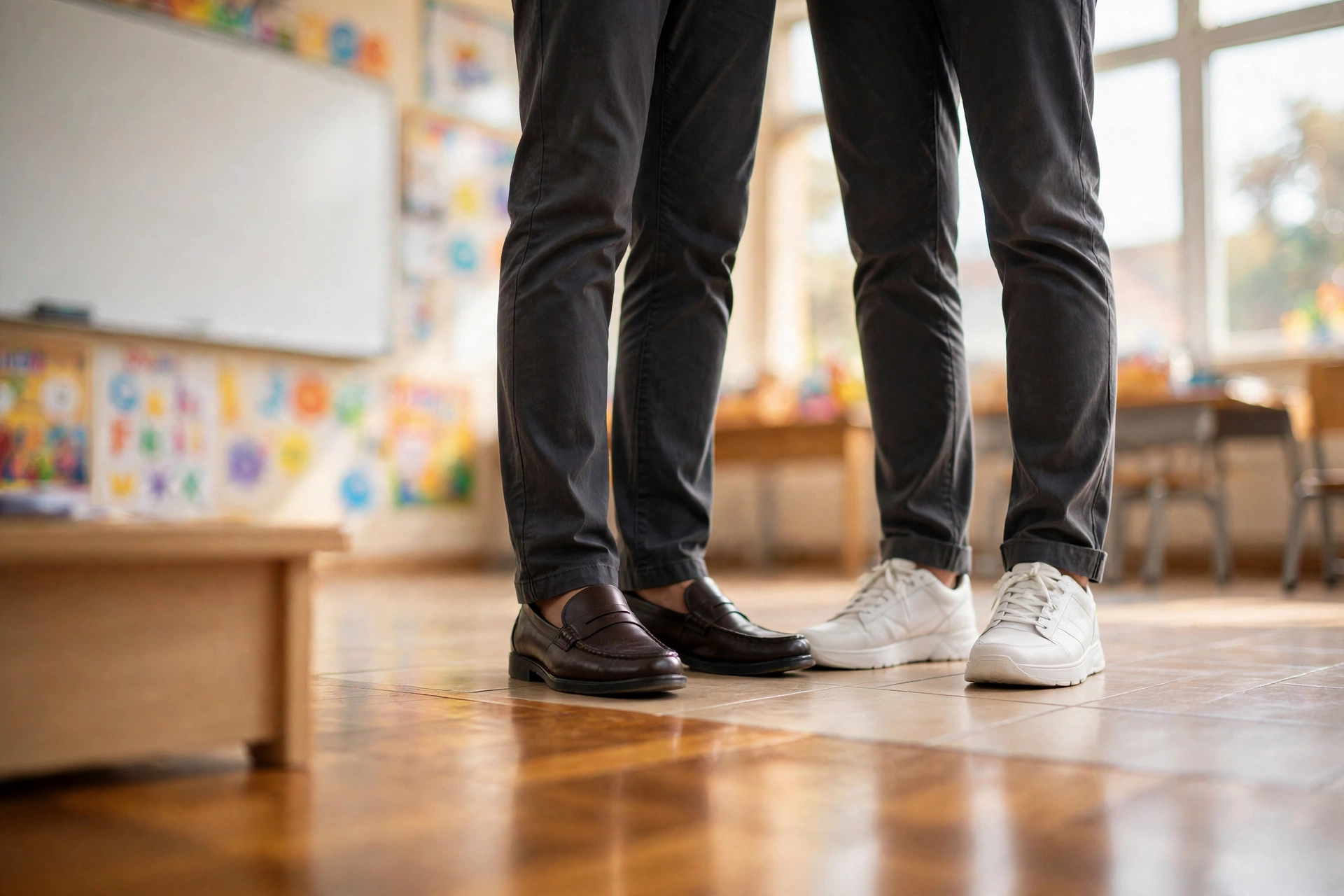
The short answer: for most teachers, the Brooks Ghost 18 at about $150 is the best all-round pick — balanced cushioning that holds up through a full school day, a 10 mm heel-to-toe drop that suits standing as well as walking, and plain black and white colourways that pass most dress codes. If you want maximum softness underfoot, the Hoka Clifton 10 at about $155 is the cushiest option. If your school expects leather shoes rather than sneakers, the Vionic Uptown Loafer at about $130 is the best dress-code-safe pick. The rest of this guide explains why those three win, and where the other five shoes in the comparison fit.
We may earn a commission if you buy through links on this page, at no extra cost to you. Read our affiliate disclosure.
What a teacher’s feet actually go through
Teaching is not standing still. A school day is hours of standing on hard tile and linoleum, punctuated by walking between classrooms, crouching beside desks, climbing stairs, and standing at a whiteboard. That mix — long static loading plus thousands of steps — is harder on shoes than either activity alone, and it explains why the shoes that work for a desk job or a weekend walk often fail by the third period.
Three mechanisms decide whether a shoe survives a school day in comfort.
First, cushioning has to last, not just feel soft in the shop. Foam compresses under load and slowly recovers when the load comes off. Cheap, soft foam feels wonderful for ten minutes and then flattens into a thin layer by mid-afternoon, leaving your feet on hard ground. Good foam — the kind in the shoes below — is resilient: it springs back between steps and still has give at 3 pm. This is why the single most useful test of a teacher shoe is not how it feels on first wear, but how it feels after six hours. Owner reports consistently separate the shoes that stay comfortable from the ones that go flat, and that is the split this roundup is built around.
Second, support is about shape, not stiffness. A contoured insole with a raised arch and a deep heel cup spreads pressure across the whole foot instead of concentrating it on the heel and the ball. A flat insole does the opposite: all your weight lands on two small points, hour after hour. You do not need a rigid orthopaedic shoe — a well-shaped removable insole, like the ones in the Dansko XP 2.0 and the Skechers Arch Fit line, does the job and can be swapped for a custom insole if you use one.
Third, fit changes during the day. Feet swell as the day goes on, so a shoe that fits perfectly at 7 am can pinch by 2 pm. That is why wide widths matter more than extra length, and why a roomy toe box is worth more than a softer insole. Shoes with stretchy knit uppers, like the Rothy’s The Point II, accommodate swelling gracefully; stiff leather that does not give will punish you for it.
Weight matters too. A shoe that is 2 oz heavier does not sound like much, but multiplied across thousands of steps it adds up to real fatigue by the end of the day. And finally, looks matter in a way they do not for most standing jobs: teachers work in front of people all day, and many schools have dress codes. A shoe has to look smart enough for the classroom, not just feel good.
The comparison
Prices are list prices checked against brand and retailer sites on 25 October 2026. Sale prices are common — the Hoka Clifton 10, for example, was widely discounted to about $101–$124 during October sales — so treat the list price as the ceiling, not the price you will necessarily pay.
| Shoe | Best for | Price | Why it works for teachers |
|---|---|---|---|
| Brooks Ghost 18 | Best all-round | About $150 | Balanced cushioning, 10 mm drop, wide widths |
| Hoka Clifton 10 | Maximum cushioning | About $155 | Thick, light foam stack; very light for its cushion |
| New Balance Fresh Foam X 1080v15 | Wide feet | About $170 | Plush foam, four width options, 6 mm drop |
| Dansko XP 2.0 | Firm, structured support | About $170 | Contoured footbed, slip-resistant, easy on and off |
| Vionic Uptown Loafer | Dress-code-safe comfort | About $130 | Contoured arch support in a leather loafer |
| Rothy’s The Point II | Washable smart flat | About $109 | Knit upper, cushioned insole, machine washable |
| Skechers Go Walk Arch Fit Unify | Best value | About $75 | Arch Fit insole, light, machine washable |
| Tieks Ballet Flats | Premium foldable flat | From about $185 | Italian leather, cushioned insole, folds for travel |
Brooks Ghost 18 — best all-round
The Ghost 18 is the safest recommendation in this roundup because it does nothing wrong. Its DNA Loft v3 foam is balanced rather than maximally soft: cushioned enough for hard floors, firm enough that it does not go flat by the afternoon. Published specs list a 10 mm heel-to-toe drop and a men’s weight of about 10.2 oz, and it comes in regular and wide widths. Owner reports consistently describe it as the shoe that disappears on your foot — no hot spots, no break-in, no surprises. At about $150 it sits in the middle of the price range, and it is the pick to start with if you have no strong preference for maximum softness, maximum structure, or a dressier look. See how it compares with other all-day options in our guide to the best shoes for standing on concrete all day.
Hoka Clifton 10 — maximum cushioning
The Clifton 10 is the softest shoe in this roundup, built around a thick stack of light foam and Hoka’s rocker sole, which rolls the foot forward with each step so the calf does less work. Its list price is $155, confirmed by Outdoor Gear Lab’s testing, though it was on sale for about $101–$124 at Hoka and Zappos in late October 2026. Measured weight is about 10.6 oz for a men’s shoe — light for the amount of foam underfoot. The trade-off is support: independent testing found it comfortable and well-fitting but less supportive and stable than some rivals, so teachers who prefer a firmer, more structured feel may like the Ghost 18 or the Dansko XP 2.0 better. The Clifton 10 is the pick for teachers who want the most cushion per gram and whose schools allow athletic-looking shoes, especially in a plain black colourway.
New Balance Fresh Foam X 1080v15 — best for wide feet
The 1080v15 is the plushest shoe here and the only one offered in four widths — narrow, standard, wide, and extra wide — which makes it the strongest pick for teachers whose feet are hard to fit. New Balance lists it at $169.99, with a 6 mm drop, a weight of 261 g (about 9.2 oz), and a new cushioning foam designed for long-lasting performance. The lower drop means less difference in height between heel and forefoot, which many standing workers find more natural for all-day wear than a high-drop shoe. The downside is the price, the highest among the sneakers here. If your feet are wide, this is the first shoe to try; if they are not, the Ghost 18 gives you similar comfort for about $20 less.
Dansko XP 2.0 — firm, structured support
The XP 2.0 is the most structured shoe in this roundup and the only clog. It is built around a removable dual-density polyurethane footbed with Dansko’s Natural Arch contour and memory foam, a lightweight EVA midsole, and a slip-resistant rubber outsole. Dansko lists it at $170, and it carries the American Podiatric Medical Association’s acceptance seal. The roomy, reinforced toe box gives toes space to spread, and the heel counter holds the heel steady while allowing it to move up and down freely — the combination that makes Dansko clogs a long-standing choice for people who stand all day. The clog style is a love-it-or-leave-it shape, and at 1.7 in of heel height it is the tallest shoe here, so try it before committing. But for teachers who want firm, defined arch support rather than soft foam, and who like a shoe that slips on and off easily, it is the best-structured option available. It also overlaps with the picks in our best shoes for 12-hour shifts guide, where the same support-first logic applies.
Vionic Uptown Loafer — dress-code-safe comfort
The Uptown Loafer is the best pick for schools where sneakers are not an option. It is a leather loafer with Vionic’s Vio Motion footbed: a contoured arch, a deep heel cup, and shock-absorbing cushioning, with a removable lightweight EVA insole. It is listed at about $130 at specialist retailers, with some outlets showing about $145. The unlined leather upper is soft and flexible rather than stiff, and the loafer collapses flat, which makes it easy to pack. The support is real but the cushioning is thinner than any sneaker here, so it suits teachers who stand and walk on flat classroom floors rather than those who want maximum softness. Pair it with a cushioned insole if you want more underfoot padding, and choose black or navy for the most versatile classroom look.
Rothy’s The Point II — washable smart flat
The Point II is a pointed-toe flat in a recycled knit upper, listed at about $109 on Rothy’s own site. Its case for teachers rests on three things: a cushioned In Love insole that runs heel to toe, a more spacious toe box than the original Point, and the fact that the whole shoe is machine washable — useful when a classroom floor, a spilled coffee, or a muddy playground duty leaves its mark. The knit upper stretches gently, which helps when feet swell in the afternoon, and the sculpted outsole adds stability that flat shoes often lack. The trade-off is the same as any flat: less cushioning and less heel support than a sneaker, and a pointed toe that some feet will not love despite the roomier fit. It is the best flat in this roundup for teachers who want a polished look with easy care, and a good second pair to keep at school.
Skechers Go Walk Arch Fit Unify — best value
At about $75, the Go Walk Arch Fit Unify is the cheapest shoe here by a wide margin, and the best value pick. It combines Skechers’ Arch Fit insole system — a contoured footbed Skechers describes as podiatrist-certified, shaped from 120,000 foot scans — with lightweight Ultra Go cushioning, a breathable mesh upper, and a machine-washable build. Amazon’s listed price on 25 October 2026 was $74.99. Owner ratings are strong, averaging about 8.8 out of 10 across more than 3,000 reviews on one price-tracking site. The compromises are durability and looks: the foam and mesh will not last as long as the Ghost 18 or the 1080v15 under daily use, and it reads as a casual sneaker rather than a smart shoe. For teachers on a tight budget, or as a second pair to rotate, it is hard to beat.
Tieks Ballet Flats — premium foldable flat
Tieks are the most expensive flats here, starting at about $185 for leather styles, with some finishes running to $235. What that buys is full-grain Italian leather that moulds to the foot over time, a foam-cushioned leather insole, a flexible split sole that bends with the foot, and a foldable design that packs into a pouch — handy for teachers who change shoes between the commute and the classroom. Teacher testimonials on Tieks’ own site describe wearing them from early morning to bedtime, and the cushioned, non-elasticised heel back is designed to hold the foot without rubbing. The price is the obvious objection: at more than twice the cost of the Rothy’s Point II, Tieks are a considered purchase rather than a practical default.
What to avoid
A few shoe types look like teacher shoes and fail in practice.
Fashion flats with no insole. A thin, flat sole with no arch contour and no cushioning concentrates pressure on the heel and ball of the foot. If a flat has no removable insole and no visible arch shape, it is a fashion item, not a work shoe.
High heels, even low ones. A heel above about an inch shifts weight forward onto the forefoot and shortens the calf over the course of the day. Save heels for meetings and parents’ evenings, not for a full teaching day.
Worn-out running shoes. A pair that was comfortable a year ago is not the same shoe now. Foam compresses permanently with use, and the outsole wears smooth under the heel first. If your current shoes feel flat by mid-afternoon, the foam is done — no insole fully restores it.
Shoes you have not walked in. Break-in is a real thing, but pain is not part of it. A shoe that pinches or rubs on day one will not magically fit on day ten. Buy from somewhere with a generous return policy, wear them indoors for a full day, and send them back if anything hurts.
How to choose between the shortlist
Start with your dress code. If sneakers are fine, choose between the Brooks Ghost 18 (balanced, best default), the Hoka Clifton 10 (softest), and the New Balance 1080v15 (widest fit range). If you need leather or a flat, choose between the Vionic Uptown Loafer (most support), the Rothy’s The Point II (washable, most forgiving fit), and Tieks (premium leather).
Then think about rotation. Two pairs worn on alternate days last longer than one pair worn daily, because foam recovers some of its shape during a rest day — and because a second pair is there when the first gets wet or needs washing. A common pairing is one sneaker for heavy walking days and one loafer or flat for days with more standing and less moving. Teachers who spend long stretches on hard floors may also want to compare with our broader work-shoes hub, which covers standing-all-day picks for other jobs, including our guide to the best shoes for chefs, where slip resistance matters more than it does in a classroom.
Finally, buy for your afternoon foot. Try shoes on late in the day, leave a thumb’s width at the toe, and prefer a wide width over a longer size. List prices in this guide were checked on 25 October 2026, but running shoes go on sale constantly, and the Clifton 10 in particular was heavily discounted in October. The best teacher shoe is the one that fits, supports, and still feels good at the final bell — not the one with the highest list price.
Research notes: prices checked against hoka.com, brooksrunning.com, newbalance.com, dansko.com, rothys.com, vionic.com retailers, skechers.com, tieks.com, and Amazon listings on 25 October 2026. No hands-on testing was done for this guide; assessments are based on published specifications, independent lab measurements where cited, and owner reports.