The short answer: if no safety toe is required, buy the Hoka Bondi SR (about $180) for maximum cushioning or the New Balance 626v2 (about $95) for durable value. If your site requires a protective toe, buy the KEEN Utility Vista Energy (about $140, carbon toe) or the Reebok Sublite Cushion Work RB4041 (about $105, alloy toe). Check the safety rule first, then buy the deepest stable cushioning you can afford, because concrete does not forgive a thin sole over a 10-hour shift.
We may earn a commission if you buy through links on this page, at no extra cost to you. Read our affiliate disclosure.
This guide is research-based, not hands-on testing. Prices are list prices checked on 2026-10-25 from brand sites, Zappos, and major retailers; street prices vary by size and color, so treat each figure as a starting point. For the wider picture, see our work shoes hub, and if your shifts are mostly standing in one spot, our guide to the best shoes for standing on concrete all day covers that angle in more depth.
What warehouse work actually demands from a shoe
A warehouse shift punishes feet through three forces: impact, repetition, and time.
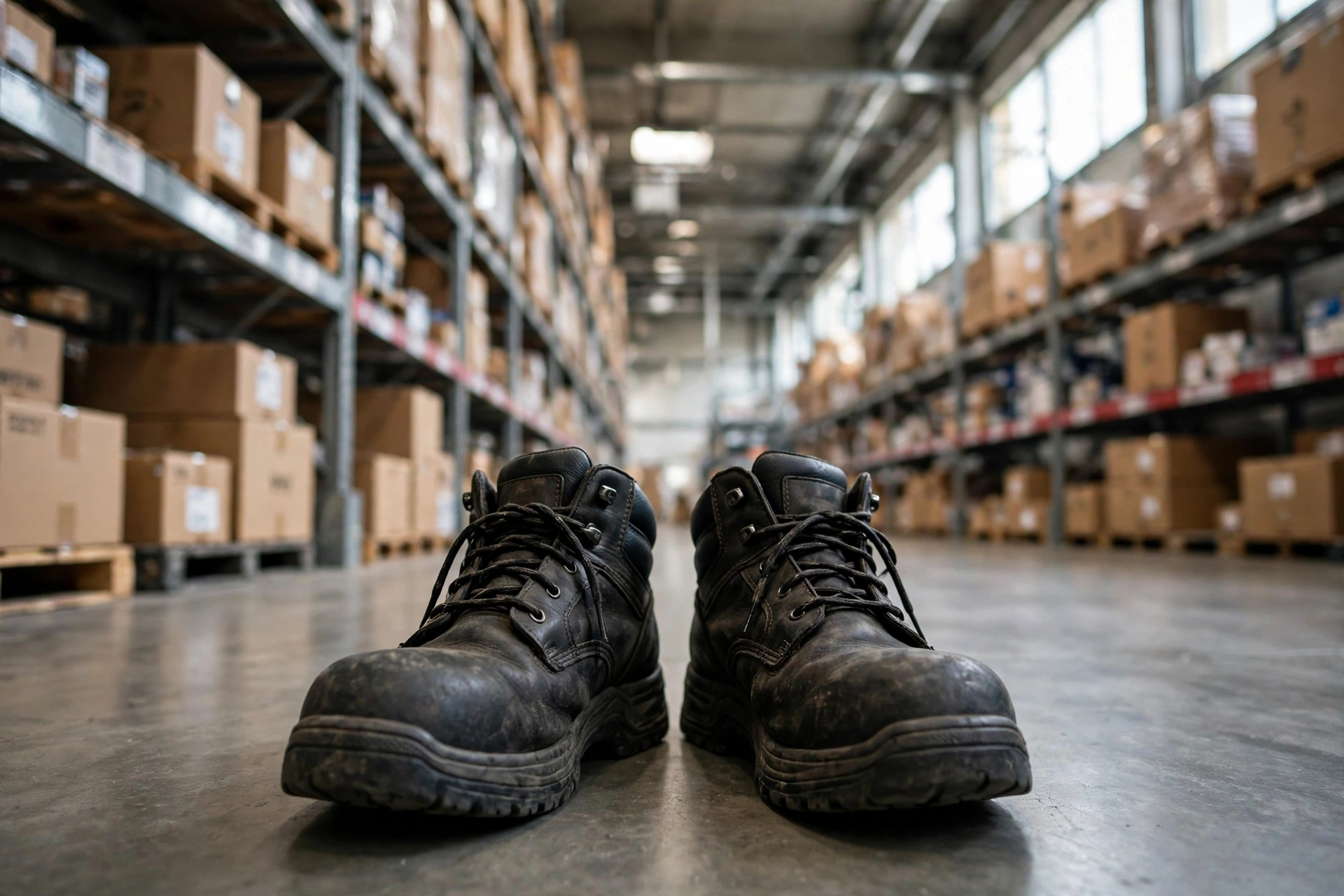
Concrete returns almost nothing. A wooden floor flexes a fraction of a millimetre under your step; packed earth and carpet give more. Sealed concrete gives essentially none of the energy back. Every footstrike sends the impact up through the heel, arch, ankle, knee, and lower back, because the floor absorbed none of it. The shoe’s midsole is the only shock absorber in the system. That is why cushioning depth matters more here than in almost any other workplace: a thin midsole bottoms out under a heavy worker after a few hours, and from that point the foot is striking concrete through a compressed slab of foam.
Repetition wears foam out, not just the outsole. A picker can cover 10 to 15 kilometres in a shift, roughly 15,000 to 20,000 steps. Each step compresses the midsole foam, and foam recovers slowly. Over weeks, the foam packs down permanently — a process called compression set — and the shoe that felt soft in week one feels flat by month four. This is the real reason warehouse shoes need replacing more often than office shoes: the cushioning dies before the upper does. A shoe with a denser, more resilient foam holds up longer than one with soft memory foam alone, which feels wonderful on day one and collapses fastest.
Time is the multiplier. Standing still is harder on feet than walking, because walking cycles pressure across the foot while standing loads the same tissue continuously — which is why static packing-station workers often hurt more than pickers who cover more distance. Support matters as much as softness: a structured arch, a firm heel counter, and a wide, stable platform spread the load instead of letting the foot collapse inward hour after hour. Pillow-soft with no structure feels good for twenty minutes and tiring by hour eight.
On top of the comfort problem, dust and cardboard debris make floors slippery even when dry, so a slip-resistant outsole earns its keep, and the upper takes abuse from racking and pallets — leather or abrasion-resistant synthetic outlasts open mesh, even though mesh breathes better.
The safety-toe question comes first
Before comparing comfort, read your employer’s footwear policy. This is the one decision you cannot get wrong by guessing.
- Safety toe required: you need a shoe rated to ASTM F2413 for impact and compression, in steel, alloy, or composite/carbon toe. Steel is the heaviest and cheapest; alloy is lighter; composite and carbon toes are the lightest and will not set off metal detectors, but they are bulkier and usually cost more. Any shoe in this guide labelled safety-rated meets the ASTM F2413 standard as published by the manufacturer — but confirm the exact rating your site requires, because some sites also require electrical-hazard (EH) or puncture-resistant soles. Do not assume one rating covers every site.
- No safety toe required: the whole comfort market opens up, and you should not pay the weight and cost penalty of a protective toe you do not need.
- Unclear: ask your supervisor or safety officer in writing. A comfortable non-safety shoe that gets you sent home is not a bargain.
Note the boundary clearly: the non-safety shoes in this guide are excellent warehouse shoes for sites that do not require protective toes, but none of them meets a safety-toe rule. Do not buy them hoping the rule will not be enforced.
Comparison table
| Shoe | Best for | Safety toe | Slip resistant | Price |
|---|---|---|---|---|
| Hoka Bondi SR | Maximum cushioning, standing-heavy shifts | No | Yes | About $180 |
| Skechers Work Arch Fit SR | Budget comfort, arch support | No | Yes | About $100 |
| Brooks Addiction Walker 2 | Stability and support, wider feet | No | Yes | About $140 |
| New Balance 626v2 | Durable value, wide widths | No | Yes | About $95 |
| KEEN Utility Vista Energy | Lightest safety shoe, athletic feel | Carbon toe | Yes | About $140 |
| Timberland PRO Powertrain Sport | Safety toe with anti-fatigue footbed | Alloy toe | Yes | About $145 |
| Reebok Sublite Cushion Work RB4041 | Cheapest light safety shoe | Alloy toe | Yes | About $105 |
| Skechers Cankton | Budget steel toe | Steel toe | Yes | About $95 |
Prices are list prices as of 2026-10-25; sale prices vary widely by size.
Hoka Bondi SR — best overall cushioning (about $180)
The Bondi SR takes Hoka’s most-cushioned running shoe and rebuilds it for work: the same deep EVA midsole, but with a water-resistant full-grain leather upper, a slip-resistant rubber outsole, and a memory-foam collar. The stack is about 41 mm at the heel — the thickest cushioning in this guide — and the wide platform keeps that height stable. Owner reports from nurses, servers, and warehouse workers consistently describe it as the shoe they reach for on the longest shifts.
The trade-offs are real: it is heavy (about 14 oz per shoe in men’s sizes), the leather upper runs warm in a hot warehouse, and it is the most expensive non-safety pick here. It also has no protective toe, so it is off the table where one is required. But for a standing-heavy shift on concrete with no safety-toe rule, nothing else in this guide cushions as deeply. Available in regular and wide widths. If your shifts run past 10 hours, also see our guide to the best shoes for 12-hour shifts.
Skechers Work Arch Fit SR — best budget comfort (about $100)
Skechers’ Arch Fit line is built around a podiatrist-designed insole system that supports the arch rather than just padding it. The SR version adds a slip-resistant outsole rated for wet, dry, and oily surfaces, plus an electrical-hazard rating. The current Arch Fit 2.0 SR lists at $100 on skechers.com; the original Arch Fit SR frequently sells for less on Amazon, often in the $60 to $70 range depending on size.
Owner reports praise the arch support and the price, and the removable insole means you can swap in your own aftermarket insole when the factory one packs down, usually around month three or four. The weakness is the cushioning itself: the foam is softer and thinner than the Hoka’s, so heavy workers and high-mileage pickers will feel it flatten sooner. For a first pair, or a second rotation pair, it is the best comfort per dollar here.
Brooks Addiction Walker 2 — best for stability and wider feet (about $140)
The Addiction Walker 2 is a leather walking shoe built for support: BioMoGo DNA cushioning that adapts to stride and weight, an Extended Progressive Diagonal Rollbar that guides the foot and resists inward roll, and a slip-resistant outsole certified to SATRA standards. Zappos lists it at $139.95, and it comes in narrow, regular, wide, and extra-wide widths — the broadest range in this guide.
This is the pick for workers whose feet roll inward or who need a firmer, more structured shoe rather than a soft one. It is heavier than it looks (about 15 oz in men’s size 10) and the full-leather upper needs a short break-in, but owner reports describe it as the shoe that stays supportive at hour ten when softer shoes have gone flat. Black is the warehouse-friendly colour choice.
New Balance 626v2 — best durable value (about $95)
The 626v2 is the workhorse of this list: a leather industrial sneaker with ABZORB crash-pad cushioning, an internal shank for stability, and an ASTM F2913 slip-resistant lug outsole, listed at $94.99 MSRP and frequently discounted to the $65 to $85 range. It is available in men’s and women’s versions, in widths up to 4E for men, which matters when feet swell over a long shift.
What sets it apart is toughness per dollar. The leather upper resists scuffs from racking and pallets far better than mesh, and the internal shank keeps the shoe from twisting under load. The cushioning is medium rather than plush, but it holds its shape longer than softer competitors, which is why it shows up in warehouse recommendations year after year. If you want one pair to last and you do not need a safety toe, this is the value pick. Note that some versions of the 626 line carry a safety toe; the standard 626v2 reviewed here does not, so check the exact model code (MID626K2 for men) before ordering.
KEEN Utility Vista Energy — best light safety shoe (about $140)
The Vista Energy is the safety shoe for workers who hate safety shoes. A carbon-fibre toe meets ASTM F2413 impact and compression standards at a fraction of a steel toe’s weight, the KEEN.ReGEN midsole returns noticeably more energy than standard EVA according to the manufacturer’s published measurements, and the KonnectFit heel capture system locks the heel in place to reduce rubbing. Shoe Carnival lists it at $140, and an ESD-rated version is available for electronics-adjacent warehouse work.
Owner reports praise the energy return and the roomy forefoot, and the carbon toe will not set off metal detectors. The mesh upper breathes well but scuffs faster than leather. For a walking-heavy picking shift where a protective toe is mandatory, this is the most athletic option available.
Timberland PRO Powertrain Sport — best safety shoe with anti-fatigue comfort (about $145)
Timberland PRO’s Powertrain Sport pairs an alloy safety toe with the brand’s Anti-Fatigue Technology footbed, a moulded insole designed to absorb shock and return energy with each step. It lists at about $145 at major retailers (Shoe Carnival lists it at $144.99; timberland.com lists the women’s version at $140). The athletic sneaker shape and breathable mesh upper make it far easier to move in than a traditional leather work boot.
The alloy toe is lighter than steel but still adds noticeable weight compared with the KEEN carbon toe, and the mesh upper is less durable against racking scuffs than leather. Where it wins is the footbed: workers who stand in one spot for long stretches report less end-of-shift tiredness than with flat safety sneakers.
Reebok Sublite Cushion Work RB4041 — cheapest light safety shoe (about $105)
The RB4041 is the budget safety pick that does not feel like one. An alloy toe meets ASTM F2413 for impact and electrical hazard, the Sublite EVA midsole provides real cushioning, and the MemoryTech removable footbed moulds to the foot. Amazon’s list price was $104.95 as of 2026-10-24, with sale prices frequently dropping to the $85 to $90 range, and the shoe carries over 10,000 ratings on Amazon — the largest owner-report base of any safety shoe in this guide.
The honest caveat is the footbed: owner reports are split, with some finding it adequate and others reporting that it compresses quickly and offers little arch support — budget for an aftermarket insole if that sounds like your feet. The mesh upper is breathable but not water-resistant. Even with that caveat, it is the cheapest way into a light, ASTM-rated safety shoe.
Skechers Cankton — best budget steel toe (about $95)
The Cankton is the cheapest steel-toe shoe in this guide, listed at $94.99 at Shoe Carnival, with Amazon sale prices sometimes dropping below $50 for specific sizes. It combines an ASTM F2413 steel toe with a memory-foam cushioned insole, electrical-hazard protection, and a slip-resistant rubber outsole, in a low-cut athletic shape far easier to walk in than a tall work boot.
Steel is the trade-off: it is the heaviest toe material here, and the Cankton feels it. The leather-and-mesh upper is durable enough for warehouse floors, but the shoe is not waterproof and offers less ankle support than a boot. For workers who need genuine steel-toe protection on a tight budget, it is the value choice.
What to avoid
- Flat fashion sneakers. A flat sole with no arch support and a thin midsole transfers every step straight to your joints.
- Running shoes with no slip rating in a warehouse that requires one. Comfort is not the only spec; a shoe that fails your site’s slip-resistance requirement is a compliance failure.
- The softest shoe on the shelf. Ultra-soft memory foam feels wonderful in the shop and packs flat within weeks under warehouse mileage. Look for dense, resilient foam and a structured heel counter, not just softness.
- Buying your normal size in a safety shoe. The protective toe cap eats space at the front — many workers go up half a size.
- One pair worn every day until it falls apart. Foam needs recovery time between shifts. Replace on cushioning death, not upper death — when the midsole feels flat or the tread is smooth, the shoe is done even if it still looks fine.
How we chose these
This is a research review, not a hands-on test. We checked the live search results for “best shoes for warehouse workers” on 2026-10-25 — the page-one results were thin affiliate roundups, outdated guides, and generic work-boot lists — then verified each pick’s current model, published specifications, and list price against at least two sources (brand sites, Zappos, Shoe Carnival, Amazon price history, and retailer listings). We excluded shoes we could not verify as current models or with no verifiable price. Prices are list prices as of 2026-10-25 and will move with sales; check the current price before ordering. If your workplace has specific footwear requirements, those requirements outrank every recommendation here.
The bottom line
Start with the safety rule, then buy cushioning. If no protective toe is required, the Hoka Bondi SR is the most comfortable warehouse shoe we found, and the New Balance 626v2 is the best value. If a protective toe is required, the KEEN Utility Vista Energy is the lightest and most athletic safety shoe, and the Reebok RB4041 is the cheapest way in. Whichever you choose, rotate two pairs, replace them when the cushioning dies, and check the fit at the end of a shift, not the start — feet swell. For kitchen work, which shares the concrete-floor and slip problem, see our best shoes for chefs.